
THE REVEAL:


ROBOT ELEMENT: CLAW
In a game where goal possession is the priority, being able to securely hold a goal is essential for success. This is where a claw comes in; the subsystem responsible for a secure and reliable hold.
The clamp of the Robot signifies effective design over unrefined power. By utilizing an over-center linkage, the claw is able to maintain its closed state, 'locking' itself to the goal, making it virtually impossible to force open.


THE CLAMP:
ROBOT ELEMENT: CLAW
In order to secure a goal for scoring Rings, a two-staged tilt system was implemented. Similar to the clamp on the front of the Robot, a claw is pneumatically powered to ensure possession of the goal. In order to score Rings on the goal, two pneumatic cylinders are used to tilt the goal at the optimal angle for scoring.
ROBOT ELEMENT: TILT

ROBOT ELEMENT: CONVEYOR
In high-level play, the ability to score rings (the purple discs found around the field) is the difference between winning and losing a match. By utilizing a chain with flaps attached, the robot is able to pick up rings off the field, and almost instantaneously process and place the Rings on the goal.
In order to maximize efficency, the robot has a direct intake-to-score system. Rather than implementing a separate mechanism for scoring Rings, the conveyor itself scores the Rings, increasing scoring speed and accuracy.


ROBOT ELEMENT: BASE/TRANSMISSION
In terms of a competitive robot, the drivetrain is a crucial aspect of the performance of the Robot. From size, speed, and torque, variations in drivetrain specs. are crucial in maintaining a competitive presence.
One of the main challenges of this year's game is to steal and hold the goals for as long as possible. To combat and meet this challenge, our team utilizes a two-speed shifting transmission. A transmission allows us to traverse the field at high speeds to snipe goals and pull/push other robots with high power.
Transmission Explained:
We have two sets of gears that can be pushed and pulled by a piston. Just like a car, the Robot has high gear and a low gear. The piston pushes and pulls a set of gears into another set of gears, changing the number of rotations needed to spin. These pneumatic changes allow us to have very fast movement or a very strong drive at a moment's notice.


ROBOT ELEMENT: LIFT
Since placing goals on top of the platform doubles the value of scoring elements on top of it, a lift mechanism is used to take advantage of the open space on the side of the platform. In tandem with the claw, the lift is able to release goals on to the platform, increasing scoring and strategy potential.


ROBOT ELEMENT: PROGRAMMING
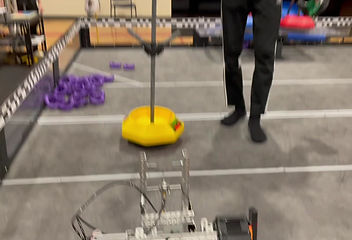
COLOR/GOAL TRACKING:
By utilizing a vision sensor (a sensor that is able to detect color and distance), the robot is able to track and follow goals until possession.
PROGRAMMING IN ACTION:


VEX ROBOTICS COMPETITION 2022-2023: SPIN UP

4 Robots. 2 Goals. 72 Discs.
Spin Up is played on a 12" by 12" field in a 'two on two' style match. The objective of the game is to score discs in the corresponding color goal (5 pts.). Robots are also able to spin the rollers on the corners of the field (10 pts.). In the last fifteen seconds, robots are able to expand horizontally without limits, with each tile the robot is touching at the end of the match scoring points (3 pts.).

CREDIT TO: PURDUE UNIVERSITY (BLRS)
FUTURE ROBOT: OVERVIEW
Drivetrain:
Looking into next year's game, we realized that maintaining a transmission (similar to the current robot) would be an effective answer to movement in an open field.
Intake:
To pick up the discs, a dual intake (an intake that can pick up the discs from both the front and the back of the robot) would increase intake and shooting speeds. Although intaking in multiple directions requires more driver practice, it increases potential autonomous and driver control scoring.
Shooting:
To shoot the discs into the goals, a single flywheel (a fast-spinning wheel) would be the best method to propel discs. Flywheels have the ability to shoot discs from long distances at a consistent arc, making it a no-brainer to pursue.
The Robot will also have adjustable shooting in two directions: vertically and horizontally. Adjustable shooting allows for the potential of shooting from multiple different angles and distances, which would increase the shot accuracy of our Robot.
Spinning:
To spin the rollers on the field, the intake will be chained (a method of power-sharing) to another set of wheels above the robot, allowing us to spin the rollers to our color with minimal precision.
Expansion:
To expand in the last 10 seconds, we are going to have six "Harpoons." These harpoons have a large amount of potential energy from extreme rubber-banding. When it releases, the harpoon will shoot across the field, making the "Robot" touch every tile the harpoon reaches. String will also follow the harpoons, making expansion reliable and easy to set up.


GALLERY:
THE TEAM:
The awesome team that made this all possible :)
